
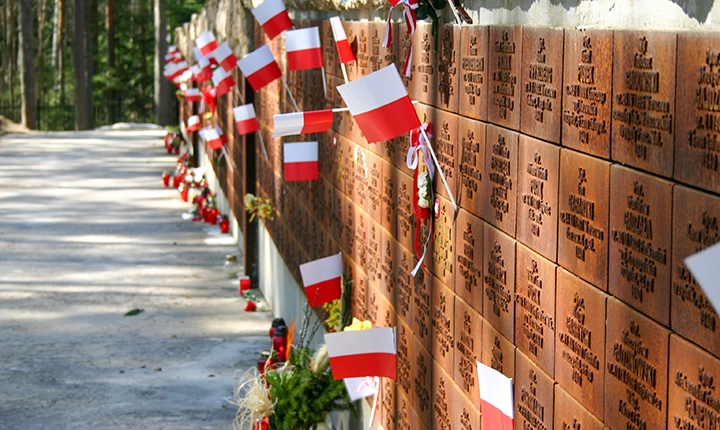
Polish War Cemetery in Katyn
opened on 28 July 2000
4,421 prisoners of the camp in Kozelsk
The world became familiar with the infamous name ‘Katyn’ on 13 April 1943, when the Germans announced the discovery of mass graves in the territories they occupied near Smolensk. The condition of the remains, as well as the documents and letters found, allowed to identify the victims as Polish prisoners of war from the NKVD special camp in Kozelsk. Specialists from the German-appointed International Medical Commission/ International Katyn Commission/Katyn Commision and the Technical Commission of the Polish Red Cross determined the time of death to be the spring of 1940, which unequivocally proved that the massacre was committed by the Soviets. In response, Stalin shifted the blame onto the Nazis. The severance of diplomatic relations with the Polish government-in-exile in London, the balance of power among the Allies, and the post-war division of the world, with the USSR subjugating part of Europe, all formed the foundation of the Katyn Lie – a narrative holding that the Katyn massacre was committed by the Nazis. On 13 April 1990, the Soviet Union admitted responsibility for the Katyn massacre.
After the German exhumations in 1943 and the investigations of the Soviet Burdenko Commission, which aimed to fabricate the evidence of the German involvement in the massacre, there remained anonymous mass graves in the Katyn Forest. Over the decades, various ‘memorials’ have appeared there, perpetuating a lie about the ‘Nazi crime’. The associations of the Katyn Families, established in 1989, strived to build cemeteries in the places of the burial of their loved ones. In the 1990s, Polish teams of specialists carried out field work and exhumations, preparing the site for the cemeteries. The team in the Katyn Forest was led by Professor Marian Głosek (Institute of Archaeology of the University of Łódź; Institute of Archaeology and Ethnology of the Polish Academy of Sciences).
An architectural project for the cemetery was selected in a competition. The authors of the winning entry were Zdzisław Pidek, Andrzej Sołyga, Wiesław and Jacek Synakiewicz, and Leszek Witkowski. The implementation project was prepared by Zdzisław Pidek and Andrzej Sołyga. The earthworks and construction works were carried out by Polish companies: Budimex S.A. and Energotechnika Sp. z o.o. from Knurów, while the sculptural elements, as well as their delivery and installation, were prepared by a consortium of Budimex S.A. and Metalodlew S.A. from Kraków. The bell was cast by Odlewnia Dzwonów Janusz Felczyński i S‑ka from Przemyśl.
According to the conceptual guidelines, developed by the Rada Ochrony Pamięci Walk i Męczeństwa (Council for the Protection of Struggle and Martyrdom Sites, which was the commissioner of this project), on each cemetery we see similar elements, illustrating a coherent message. The main material is cast iron, chosen for its durability.
The cornerstone was laid on 4 June 1995, and the cemetery was opened on 28 July 2000.
When entering the Polish War Cemetery in Katyn, we see pylons bearing Polish military eagles and the crosses of the Virtuti Militari, as well as the 1939 September Campaign, which were destroyed by the Russians in 2025. The outline of the cemetery is marked by a wall with epitaph plaques: name, surname, date and place of birth, military rank, profession or official position. An element common to all the plaques is the date of death: 1940. In the Katyn Forest, the natural height difference of the terrain was used so that those walking the path along the wall feel as if they were below ground level.
Further on, among the trees, the cast iron plaques cover the death pits. This is where Polish prisoners of war died and were originally buried. The remains recovered by the Polish teams of specialists now rest in the common graves at the centre of the cemetery. The only exceptions are the individual graves of the generals Mieczysław Smorawiński and Bronisław Bohaterewicz, who were identified as early as in 1943.
On one side of the central square stands the Gate of Remembrance, on which the names and surnames of all the victims are listed in alphabetical order. This gate opens as on the morning of the Resurrection, with the cross visible in the background. A bell tolling for the dead was hung in the underground niche and inscribed with the verses from Bogurodzica [Mother of God]. In front of the gate stands the Meeting Table, where visitors can gather and the liturgy is performed during the commemoration ceremonies. On the axis, on the opposite side of the Gate, there are symbols of religions professed by the citizens of the Second Polish Republic who rest here: the crosses of Eastern and Western Churches, the Star of David, and the Islamic Crescent and Star.
Beyond the wall of the Polish cemetery lies Grave No. 8, and the uncounted and unexplored nameless graves of the Russians, who died here during Stalinist purges in the 1930s.
Information about the victims can be found in the edited volume Katyń. Księga Cmentarna Polskiego Cmentarza Wojennego [Katyn. The Cemetery Book of the Polish War Cemetery], published by the Rada Ochrony Pamięci Walk i Męczeństwa (Council for the Protection of Struggle and Martyrdom Sites) in the year 2000.
More information about the establishment of the cemetery in Katyn can be found in the sections TIMELINE and RECOLLECTIONS.
Text prepared by Izabella Sariusz-Skąpska
Translated by Ilias Stanekzai