
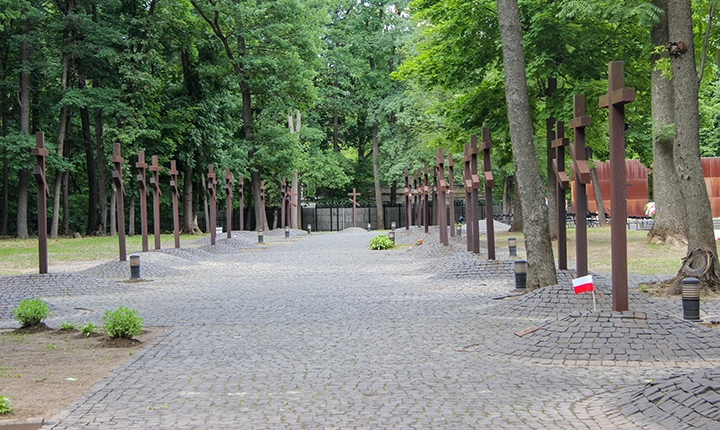
Cemetery of the Victims of Totalitarianism in Piatykhatky, Kharkiv
opened 17 June 2000
4,302 prisoners of the camp in Starobilsk
The name of this cemetery is significant: in the Piatykhatky forest complex, once near Kharkiv, today within the administrative boundaries of the city, lie the victims of the Stalinist purges of the 1930s. They died in a big Kharkiv prison, which was infamous even in tsarist times. The bodies were brought to a suburban forest and buried chaotically in unmarked graves. The same happened with the bodies of the Katyn massacre victims – prisoners of war who were brought to Kharkiv from the NKVD special camp in Starobilsk to be executed.
We did not learn that they were buried in Piatykhatky until the 1990s. During the exhumation, Polish teams of specialists were unable to clearly separate the graves of the citizens of the Second Polish Republic. Moreover, it turned out that sometime in the late 1970s – beginning of the 1980s, the forest was ploughed by geological drills. In this way the Soviets attempted to cover up the traces of their crimes. These circumstances led to a modification of the original cemetery layout and the choice of the name, emphasising the shared fate of Polish citizens and the representatives of the nations of the Soviet Union.
Between 1994 and 1996, the team of Polish archaeologists conducting a research in Piatykhatky was led by Professor Andrzej Kola (Institute of Archaeology and Ethnography, Nicolaus Copernicus University in Toruń). As in Katyn, an architectural project for the cemetery was selected in a competition (the authors of the winning entry were Zdzisław Pidek, Andrzej Sołyga, Wiesław and Jacek Synakiewicz, and Leszek Witkowski). The implementation project was prepared by Zdzisław Pidek and Andrzej Sołyga. Earthworks and construction were carried out by Budimex S.A., while the sculptural elements were prepared by a consortium of Budimex S.A. and Metalodlew S.A. from Kraków. The bell was cast by Odlewnia Dzwonów Janusz Felczyński i S‑ka from Przemyśl.
According to the conceptual guidelines, developed by Rada Ochrony Pamięci Walk i Męczeństwa (Council for the Protection of Struggle and Martyrdom Sites, which was the commissioner of this project), on each cemetery we see similar elements, illustrating a coherent message. The main material is cast iron, chosen for its durability.
The cornerstone was laid on 27 June 1998, and the cemetery was opened on 17 June 2000.
At the entrance of the Cemetery of the Victims of Totalitarianism in Kharkiv, there are pylons bearing the Polish military eagle and the Ukrainian coat of arms, as well as the crosses of the Virtuti Militari and the 1939 September Campaign.
The outline of the cemetery is marked by the ‘black road’. Its windings are marked with burial mounds made of black basalt stones, covering mass graves. On the mounds there are crosses of the Eastern and Western Churches, thus commemorating both Polish prisoners of war and Ukrainians murdered in the 1930s. The axis of the cemetery is the alley lined with the epitaph plaques commemorating Polish prisoners of war, bearing their names and surnames, dates and places of birth, military ranks, professions or official positions. One element common to all the plaques is the date of death: 1940.
On one side of the alley, there is a collective Ukrainian epitaph in the form of a cast-iron wall bearing an Orthodox cross, and on the opposite side stands the Gate of Remembrance, on which the names and surnames of the victims of the Katyn massacre who rest here are listed in alphabetical order. A bell hangs at the foot of the gate, in an underground niche, for it tolls for the dead. The bell is inscribed with verses from Bogurodzica. In front of the gate stands the Meeting Table, where visitors can gather and the liturgy is performed during the commemoration ceremonies. The symbolism is completed by the insignia of the religions professed by those who rest here: the crosses of Eastern and Western Churches, the Star of David, and the Islamic Crescent and Star.
Information about the victims can be found in the edited volume Charków. Księga Cmentarna Polskiego Cmentarza Wojennego [Kharkiv. The Cemetery Book of the Polish War Cemetery], published by Rada Ochrony Pamięci Walk i Męczeństwa (Council for the Protection of Struggle and Martyrdom Sites) in the year 2003.
More information about the establishment of the cemetery in Kharkiv can be found in the sections TIMELINE and RECOLLECTIONS.
Text prepared by Izabella Sariusz-Skąpska
Translated by Ilias Stanekzai