
Polish War Cemetery in Mednoye
opened 2 September 2000
6,296 prisoners of the camp in Ostashkov
When the exhumations were carried out by Polish specialists in the 1990s in the forest near the village of Mednoye, near Tver (renamed Kalinin in the Soviet era), they uncovered pits filled with dark blue clay. This strange finding was explained when other artefacts, such as buttons, buckles, and fragments of insignia, were dug up. All of these things matched police uniforms. The majority of the Katyn massacre victims buried here were Polish police officers. In the spring of 1940, the prisoners of the NKVD special camp in Ostashkov were transported to Tver, where they were executed in the basements of the NKVD Regional Directorate, and their bodies were dumped into mass graves in Mednoye.
Same as in Kharkiv and Bykivnia, we didn’t learn about this place o burial of the Katyn massacre victims until the 1990s. The forest also hides the nameless graves of the Russians, who died during Stalinist purges in the 1930s.
Between 1994 and 1995, measurement tests and exhumations were conducted here under the supervision of Professor Bronisław Młodziejowski (Academy of Internal Affairs, University of Warmia and Mazury), a specialist in the field of forensic biology and osteology. The architectural project for the cemetery was selected in a competition. The authors of the winning entry were Zdzisław Pidek, Andrzej Sołyga, Wiesław and Jacek Synakiewicz, and Leszek Witkowski. The implementation project was prepared by Zdzisław Pidek and Andrzej Sołyga.
Earthworks and construction were carried out by Budimex S.A., while the sculptural elements were prepared by a consortium of Budimex S.A. and Metalodlew S.A. from Kraków. The bell was cast by Odlewnia Dzwonów Janusz Felczyński i S‑ka from Przemyśl.
According to the conceptual guidelines, developed by the Rada Ochrony Pamięci Walk i Męczeństwa (Council for the Protection of Struggle and Martyrdom Sites, which was the commissioner of this project), on each cemetery we see similar elements, illustrating a coherent message. The main material is cast iron, chosen for its durability.
The cornerstone was laid on 11 June 1995, and the cemetery was opened on 2 September 2000.
At the entrance of the Polish War Cemetery in Mednoye, there are pylons, on which the crosses of the Virtuti Militari and the 1939 September Campaign were mounted (destroyed by the Russians in May 2025). The plaque in the centre of the cemetery states that this site was built ‘In honour of over 6,300 victims buried in Mednoye – officers of the State Police and the Silesian Voivodeship Police, the Border Guard and the Prison Guard, soldiers and officers, military police, Border Protection Corps and other military formations, as well as the state administration and justice system employees’.
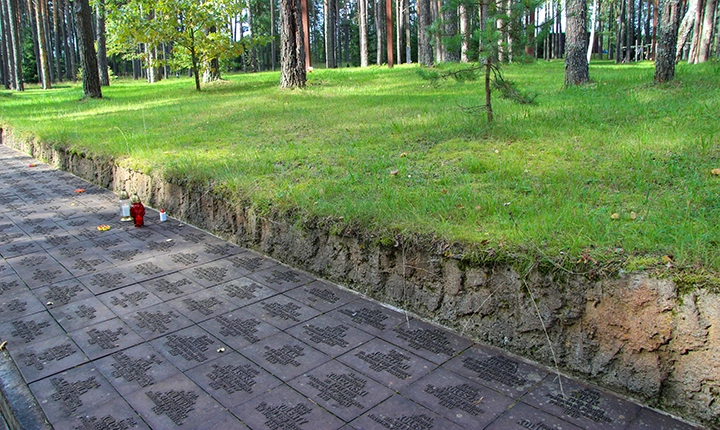
The cemetery is surrounded by an alley, lined with the epitaph plaques commemorating Polish prisoners of war, bearing their names and surnames, dates and places of birth, military ranks, professions or official positions. One element common to all the plaques is the date of death: 1940.
Deep in the forest, you can see the towering silhouettes of the crosses placed over the mass graves.
Similarly to Katyn and Kharkiv, a distinctive spot is the Gate of Remembrance, on which the names and surnames of the victims of the Katyn massacre buried here are listed in alphabetical order. A bell that tolls for the dead hangs at the foot of the gate. The bell is inscribed with verses from Bogurodzica. In front of the gate stands the Meeting Table, where visitors can gather and the liturgy is performed during the commemoration ceremonies. The symbolism is completed by the insignia of the religions professed by those who rest here.
Further in the woods there is a symbolic obelisk, dedicated to the Russian victims of the Great Purge of 1937.
Information about the victims can be found in the edited volume Miednoje. Księga Cmentarna Polskiego Cmentarza Wojennego [Mednoye. The Cemetery Book of the Polish War Cemetery], published by the Rada Ochrony Pamięci Walk i Męczeństwa (Council for the Protection of Struggle and Martyrdom Sites) in the year 2006.
More information about the establishment of the cemetery in Mednoye can be found in the sections TIMELINE and RECOLLECTIONS.
Text prepared by Izabella Sariusz-Skąpska
Translated by Ilias Stanekzai