
Polish War Cemetery in Bykivnia, Kyiv
opened 21 September 2012
3,435 prisoners from Ukraine
Paradoxically, the decision to build the forth Katyn cemetery in Bykivnia was the hardest one to negotiate. As in Katyn, during the time when Ukraine was a part of the Soviet Union, the officials claimed that the people buried in the forest near Kyiv were killed by Nazis during the occupation. Starting from the 1970s, the mass graves were dug up, destroying the remains and covering the evidence with layers of soil. During the period of glasnost’, provisional works were carried out there and it was finally admitted, that the remains buried in Bykivnia belong to the victims of the Great Purge of 1937.
When the ‘Ukrainian trace of Katyn’ appeared in 1994 and the so-called ‘Ukrainian Katyn List’ was revealed, the search began for the places of death and burial of 3,435 prisoners, citizens of the Second Polish Republic, held in prisons in Western Ukraine. Once again, the team of Polish archaeologists was led by Professor Andrzej Kola (who had previously conducted work in Kharkiv), but even when the evidence of the burial of Polish citizens was found, the Ukrainian side firmly denied that they were victims of the Katyn massacre, arguing that many inhabitants of the Kyiv region had Polish roots and that the remains found belong to the victims from the 1930s.
In 2007, a breakthrough was made when the military identification tag of Senior Sergeant Józef Naglik, commander of the Border Protection Corps, was found (information about him was previously recorded in the Ukrainian Katyn List). That same year the first grave was created in Bykivnia, and the remains recovered by the Polish teams in 2001, 2006 and 2007 were laid to rest there. During the ceremony commemorating the 70th anniversary of the Katyn massacre in Kharkiv, Ukrainian prime minister Mykola Azarov unexpectedly announced the approval for the construction of the cemetery in Bykivnia. Rada Ochrony Pamięci Walk i Męczeństwa (Council for the Protection of Struggle and Martyrdom Sites) has announced the competition for an architectural project in line with the conceptual guidelines of the previously built Katyn cemeteries. The design by Marek Moderau’s studio was selected. The dominant material in this cemetery is granite.
The foundation act was laid on 28 November 2011, and urns containing soil from Katyn, Kozelsk, Ostashkov, Mednoye, Kharkiv, and Warsaw, served as the cornerstone. The Polish War Cemetery in Bykivnia was opened on 21 September 2012.
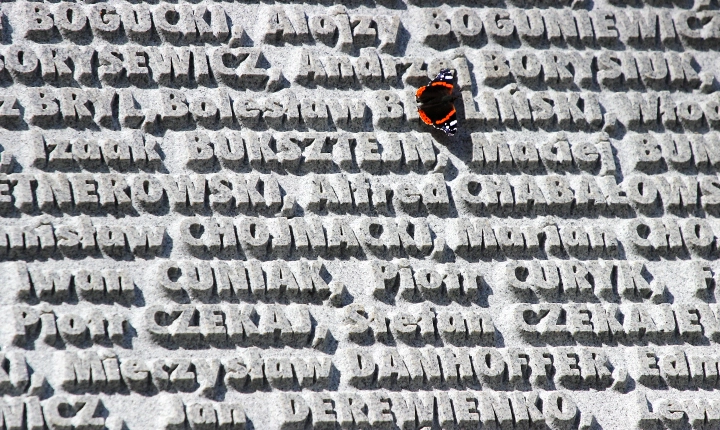
The commemoration is partly symbolic, as it is known that not all of the victims from the so-called Ukrainian Katyn List are buried here. An entrance is guarded by the pylons bearing Polish military eagles. The cemetery area is marked by a cobbled path, lined with granite epitaph plaques, bearing the victims’ names and surnames, dates and places of birth, military ranks, professions or official positions. In the centre, there is a common grave to which the recovered remains were transferred, and at the opposite end of the square stands the Gate of Remembrance, cut by a cross, as if struck by lightning. There one can find names and surnames of all the victims. The site is complemented by the bell tower, bearing the symbols of religions: the crosses of Eastern and Western Churches, the Star of David, and the Islamic Crescent and Star. The bell is inscribed with the fragment of the poem by Feliks Konarski (pen name ‘Ref-Ren’).
In the Ukrainian section of the memorial site there is a monument, a burial mound and collective epitaph plaques.
More information about the establishment of the cemetery in Bykivnia can be found in the sections TIMELINE and RECOLLECTIONS.
For further details, see GUIDE.
Text prepared by Izabella Sariusz-Skąpska
Translated by Ilias Stanekzai